
Biocompatibility for Medical Device

Biocompatibility testing for medical devices is crucial to ensure their safety and effectiveness.

At HBI, we understand the importance of timely and precise biocompatibility testing. 

Our dedicated team works closely with clients to design and execute customized testing protocols that meet their specific needs and regulatory requirements. 

By partnering with us, you can be confident that your biocompatibility testing is conducted with the highest level of scientific integrity and operational efficiency, paving the way for the successful development and approval of your medical devices.

In vitro testing assesses the interaction of the device with biological systems at a cellular or molecular level, providing valuable insights into cytotoxicity, genotoxicity, and hemocompatibility.

In vivo testing involves evaluating the device’s performance within living organisms.
This testing helps assess the device’s biocompatibility, including its inflammatory response, tissue reaction, and potential systemic effects.
By combining both in vitro and in vivo testing approaches, comprehensive biocompatibility assessments can be achieved, ensuring that medical devices meet regulatory standards and are safe for patient use.


In Vivo Biocompatibility

At HBI, we specialize in conducting comprehensive in vivo biocompatibility tests to ensure the safety and efficacy of medical devices and materials. 

Biocompatibility testing is a critical step in the development of any medical device, as it assesses the interaction between the device and the biological environment.

Our expert team utilizes a range of animal models to evaluate the biocompatibility of materials, ensuring that they do not induce adverse effects when implanted or in contact with biological tissues.

Our in vivo biocompatibility

Biocompatibility testing ensures that a medical device is safe for use in the human body and doesn’t produce adverse biological responses. These tests are a regulatory requirement for device approval.

Most in vivo assays are based on guidance from:

  • ISO 10993 series: The global standard for biocompatibility testing.
  • FDA Guidance (U.S.)
  • OECD Guidelines (supportive for toxicological endpoints)
  • GLP compliance (Good Laboratory Practice) required for regulatory submissions.

We offer a variety of tests, including acute, subacute, and chronic toxicity studies, irritation and sensitization assays, and implantation studies

These tests help to identify any potential cytotoxic, genotoxic, or immunotoxic responses, providing a thorough assessment of the material’s safety profile.

Using advanced techniques and state-of-the-art equipment, we meticulously monitor and analyze the biological responses to the tested materials. 

Our detailed histopathological examinations and comprehensive data analysis ensure that all aspects of biocompatibility are thoroughly evaluated. 

This rigorous approach enables us to provide reliable and accurate results, which are crucial for the regulatory approval process and the successful commercialization of medical devices.


In Vitro Biocompatibility

Cytotoxicity Assays – 

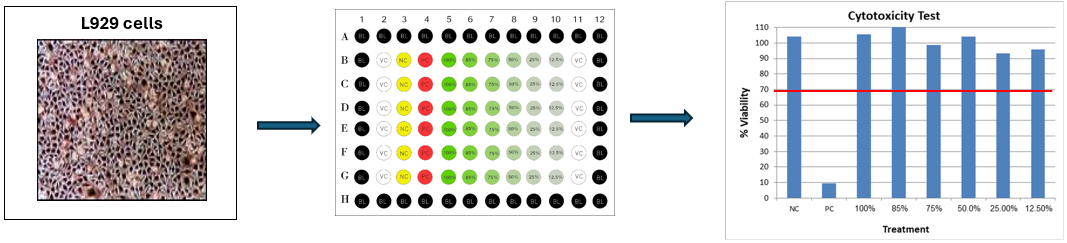
Cytotoxicity effect of Medical Devices and Materials are evaluated in mouse fibroblast cells (L929) test system. There are two kind of Cytotoxicity tests: MEM Elution-Extraction Method and Agar Overlay.


MEM Elution-Extraction Method – 

ISO 10993

Test Devices or materials are extracted in cell culture media (MEM). 

Following  extraction, cells are exposed to the extract and allowed to grow for 24 hours. 

Test device toxicity is quantitatively measured using MTT or XTT indicators which assesses the metabolic activity of cells takes place.

Test materials are considered non cytotoxic when cells viability is  ≥ 70%.
Agar Overlay:

ISO 10993-5 or ISO 7405 (for dental materials):

The Agarose Overlay test is suited for Test Device or Materials that contacts unbirched skin. 

This method is used for testing the non-specific cytotoxicity of leachable components of test substances after diffusion through agarose.

The material is placed on top of agar that is overlayed on L929 cells monolayer and incubated for 24 hours, followed by cells  stained with MTT solution. 

The decolorization zone is evaluated based on criteria detailed in the relevant guidelines according to guidelines definition.

Test materials are considered non cytotoxic if the cytotoxic response is NOT greater than Mildly-Reactive.

Cytotoxicity for Nanoparticles –

ASTM F756

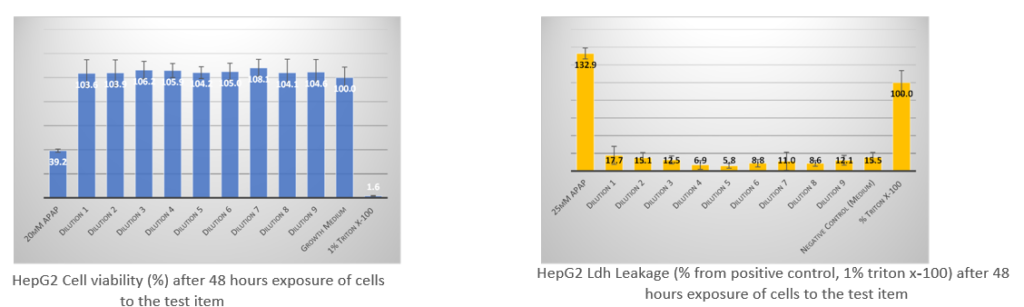
Cytotoxicity effect of Nanoparticulate Materials are evaluated in Porcine Kidney Cells (LLC-PK1) and Human Hepatocarcinoma cells (HepG2).

The test method consisted of two quantitative indicators for estimation of cytotoxicity:
lactate dehydrogenase (LDH) release and MTT reduction. 

The release of LDH indicates membrane damage and MTT reduction indicates loss of cell viability.
Hemolysis Assays –

ASTM F756

Hemolysis effect of Medical Devices and Materials are evaluated using rabbit whole blood. 

It evaluates damage to erythrocytes, either by direct methods, which determine hemolysis due to physical and chemical interactions with erythrocytes, or by indirect methods, which determine hemolysis due to extractable from Medical Devices and Materials.

During the test, Hemoglobin content in the plasma is measured before and after incubation of rabbit whole blood with the Test Item (Medical Device/Material/Extract).

Hemoglobin is measured using Drabkin’s method, which is quantitative colorimetric determination of hemoglobin concentration in whole blood.

Test materials are considered non hemolytic when the hemolytic Index is no more then 2% above the Negative Control.

Hemolysis Assays -

ASTM F756

Hemolysis effect of Medical Devices and Materials are evaluated using rabbit whole blood. 

It evaluates damage to erythrocytes, either by direct methods, which determine hemolysis due to physical and chemical interactions with erythrocytes, or by indirect methods, which determine hemolysis due to extractable from Medical Devices and Materials.

During the test, Hemoglobin content in the plasma is measured before and after incubation of rabbit whole blood with the Test Item (Medical Device/Material/Extract).

Hemoglobin is measured using Drabkin’s method, which is quantitative colorimetric determination of hemoglobin concentration in whole blood.

Test materials are considered non hemolytic when the hemolytic Index is no more then 2% above the Negative Control.

Consulting Services for Animal Facility Maintenance / Breeding​

At HBI, we offer expert consulting services to optimize animal facility maintenance and breeding programs.

Our CEO Dr. Nati Ezov can help you with tailored solutions to enhance the efficiency, health, and welfare of laboratory animals.

We offer comprehensive assessments of facility infrastructure, including HVAC systems, biosecurity protocols, and environmental enrichment strategies, to ensure optimal conditions for animal welfare and research integrity. Additionally, we provide strategic guidance on breeding program management, genetic diversity enhancement, and reproductive health monitoring to support sustainable and successful animal colony management.

Whether you’re establishing a new facility or seeking to improve existing operations, HBI is dedicated to fostering excellence in animal care and research outcomes.

Scientific consultation

  • Positioning as a full-service, high-quality CRO specifically for preclinical research
  • Supporting clients from discovery through early clinical phases
  • Focus areas of expertise like pharmacology, toxicology, etc.
  • Commitment to scientific excellence through investments, talent, quality control
  • Emphasis on collaboration and customer service
  • End goal of providing data to clients to advance best candidates into clinics

GLP archive

HBI comprehensive Good Laboratory Practice (GLP) Archive Service, is designed to ensure the secure and organized storage of your invaluable scientific data and documentation. It is maintained to meet the stringent standards of GLP, providing a secure and controlled environment for the retention of critical records from your preclinical research studies. 

With a commitment to data integrity and compliance, our GLP Archive Service offers a systematic and traceable approach to document storage, retrieval, and maintenance. 

Whether you require the archiving of raw data, study protocols, pathology slides & blocks, fixed wet tissues, electronic data or quality control records, our service aims to safeguard your research legacy, facilitating regulatory compliance and future scientific inquiries.

Our archiving services can be provided as part of a study or as a stand-alone service.


Partner with us for a reliable and tailored GLP archive solution that ensures the longevity and accessibility of your vital scientific records.

Histopathology Evaluation and Reporting​

Toxicological pathology is crucial in the evaluation of potential toxic effects of substances on biological tissues and organs.

This field combines pathology and toxicology to assess adverse effects, identify target organs, and elucidate mechanisms of toxicity.

At HBI Biotech Sciences, we provide comprehensive histopathological evaluation services, offering detailed analysis to support risk assessment, regulatory approval, and the safe development of medical devices, pharmaceuticals, chemicals, and other products. Our expertise in toxicological pathology ensures thorough assessment and helps ensure human and environmental safety by identifying potential hazards before they reach the market.

Histopathology evaluation and reporting can be provided as an integral part of the study execution and report or as a stand-alone service. This service may be GLP-compliant or non-GLP as required and may include incorporation of microphotographs in accordance with FDA requirements (e.g., FDA Guidance for Industry issued on March 28, 2023 – General Considerations for Animal Studies Intended to Evaluate Medical Devices) and may include, upon request, the issue of a Histopathology Phase Report. 

Bio-products

At HBI, we offer a comprehensive range of bioproducts sourced from both laboratory and farm animals (to some extent), tailored to meet the diverse needs of our clients.

Our offerings include blood products, organs, and tissues, each meticulously collected and processed according to your specific requirements.

Whether you need whole blood, plasma, serum, or other derivatives, our expert team ensures that all blood products are handled with the highest standards of care and precision. Additionally, we provide a variety of organs and tissues, harvested and preserved to maintain their integrity and viability for your research applications. Understanding the critical importance of proper storage, we offer flexible solutions, delivering your bioproducts under various conditions—frozen, refrigerated, or ambient—based on the nature of the materials and your project needs.

Our commitment to quality and customization ensures that you receive reliable, high-quality bioproducts that support your research and development goals. 

In vivo procedures

At HBI, we specialize in performing a variety of in vivo stand-alone special procedures essential for preclinical research. Our expert team is skilled in techniques such as cannulation, splenectomy, castration, and ovariohysterectomy, among others. These procedures are critical for studying disease mechanisms, evaluating therapeutic interventions, and assessing physiological responses in animal models.

We adhere to stringent protocols and ethical standards to ensure the safety, well-being, and humane treatment of all animals involved. Whether you require a single procedure or a combination of techniques, we provide precise and reliable services tailored to meet your specific research objectives. Trust HBI to deliver exceptional results with a focus on scientific rigor and ethical animal care practices.

Ex – vivo

Ex vivo studies play a pivotal role in our research methodology, allowing us to explore the intricate details of biological processes outside the living organism. In these studies, we carefully extract tissues, cells, or organs from the organism of interest and conduct meticulous analyses in controlled laboratory settings.
Our ex vivo studies serve as a powerful tool for understanding cellular mechanisms, assessing the effects of interventions, and gaining insights that contribute to the advancement of scientific knowledge. By leveraging ex vivo methodologies, we aim to uncover valuable information that can inform and enhance our understanding of various physiological and pathological processes, ultimately contributing to the development of innovative and targeted solutions.
Ex vivo services/studies – abundant possibilities suited for customer’s needs, including establishment on site and using various species as origin. Examples:

  • Ex vivo tests on skin samples
  • Ex vivo tests on eyes
  • Ex vivo tests on blood products

Health Monitoring for Laboratory Animals​

Various services for live animals delivered or for samples delivered, such as:

  • Gross necropsy of animals including samples collection for bacteriology, serology, dermatophytes and parasitology, in accordance with FELASA profiles per species or according to specific requests.
  • Bacteriology testing from swabs delivered and collected from live animals
  • Serology testing from fresh or frozen samples delivered and collected from immunocompetent or immunosuppressed animals.
  • PCR testing for specific pathogens of Laboratory Animals (either from samples collected on-site or from samples delivered).
  • Sterility testing (e.g., bacterial spore test strips of bacillus stearothermophilus)

Nati Ezov, DVM

Co- Founder and CEO

Dr. Nati Ezov has co-founded Harlan Biotech Israel (known today as HBI Biotech Sciences and Harlan Laboratories) in 1995 and since 1996 he serves as the CEO of both companies. 
As an entrepreneur in the fields of biopharmaceutical research and development, Nati led HBI Biotech Sciences (HBI) from a small CRO (under global ownership) providing specific preclinical research models and services, to be the largest private Israeli CRO company that provides full designated service to meet the requirements of our clients, local and abroad. Taking advantage of the knowledge and experience gained under the different global ownerships, he pioneered with implementation of international quality standards for preclinical trials in Israel, fostering and cultivating global collaborations and partnerships to become a prominent figure in the local preclinical research arena.

Prior to the founding of HBI, Nati was Chief Animal Technician and the Chief Veterinary Officer at Bio-Technology General Ltd. (BTG), where he gained knowledge and experience in maintenance of animals’ facilities and treatment, health care and use of laboratory animals. As a worldwide expert in the field, he provided consultation to many biotechnology companies through their different preclinical and clinical R&D stages.   

Dr. Ezov was among the four veterinarians to establish the Israeli Laboratory Animal Forum (ILAF) in 1998, aimed to serve as the primary professional body in Israel, advancing the fields of laboratory animals medicine and research and the Israeli representative in the European societies.

Throughout the years, Nati has attended workshops and completed professional courses worldwide such as microsurgical procedures workshop (England), pharmacokinetics and bioavailability of drugs (Israel) and laboratory animal sciences course (the Netherland). He has collaborated with many researchers from international institutions and appears in tens of peer-reviewed scientific articles.  

Dr. Ezov holds a degree of Doctor of Veterinary Medicine (DVM) from the Hebrew University of Jerusalem (HUJI), and a M.Sc and B.Sc from the Faculty of Agriculture, HUJI. Additionally, Nati was certified as a diplomate of expertise in laboratory animal medicine from the European College of Laboratory Animal Medicine (ECLAM) and as a Veterinary Specialist in Laboratory Animal in the veterinary services by the Ministry of Agriculture in Israel.