
Biocompatibility for Medical Device
Biocompatibility testing for medical devices is crucial to ensure their safety and effectiveness.
At HBI, we understand the importance of timely and precise biocompatibility testing.
Our dedicated team works closely with clients to design and execute customized testing protocols that meet their specific needs and regulatory requirements.
By partnering with us, you can be confident that your biocompatibility testing is conducted with the highest level of scientific integrity and operational efficiency, paving the way for the successful development and approval of your medical devices.
In vitro testing assesses the interaction of the device with biological systems at a cellular or molecular level, providing valuable insights into cytotoxicity, genotoxicity, and hemocompatibility.
In vivo testing involves evaluating the device’s performance within living organisms.
This testing helps assess the device’s biocompatibility, including its inflammatory response, tissue reaction, and potential systemic effects.
By combining both in vitro and in vivo testing approaches, comprehensive biocompatibility assessments can be achieved, ensuring that medical devices meet regulatory standards and are safe for patient use.
In Vivo Biocompatibility
At HBI, we specialize in conducting comprehensive in vivo biocompatibility tests to ensure the safety and efficacy of medical devices and materials.
Biocompatibility testing is a critical step in the development of any medical device, as it assesses the interaction between the device and the biological environment.
Our expert team utilizes a range of animal models to evaluate the biocompatibility of materials, ensuring that they do not induce adverse effects when implanted or in contact with biological tissues.
Our in vivo biocompatibility
Biocompatibility testing ensures that a medical device is safe for use in the human body and doesn’t produce adverse biological responses. These tests are a regulatory requirement for device approval.
Most in vivo assays are based on guidance from:
- ISO 10993 series: The global standard for biocompatibility testing.
- FDA Guidance (U.S.)
- OECD Guidelines (supportive for toxicological endpoints)
- GLP compliance (Good Laboratory Practice) required for regulatory submissions.
We offer a variety of tests, including acute, subacute, and chronic toxicity studies, irritation and sensitization assays, and implantation studies.
These tests help to identify any potential cytotoxic, genotoxic, or immunotoxic responses, providing a thorough assessment of the material’s safety profile.
Using advanced techniques and state-of-the-art equipment, we meticulously monitor and analyze the biological responses to the tested materials.
Our detailed histopathological examinations and comprehensive data analysis ensure that all aspects of biocompatibility are thoroughly evaluated.
This rigorous approach enables us to provide reliable and accurate results, which are crucial for the regulatory approval process and the successful commercialization of medical devices.
In Vitro Biocompatibility
Cytotoxicity Assays –
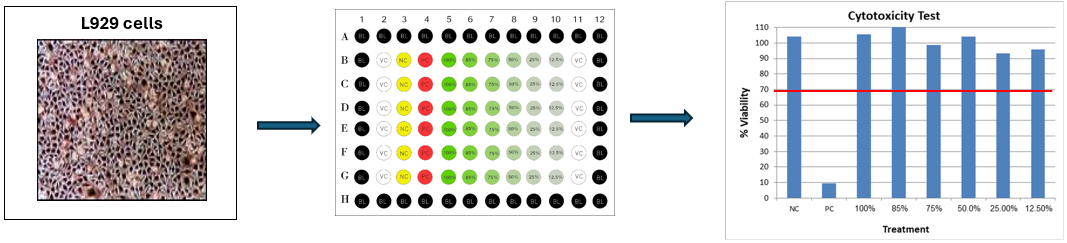
Cytotoxicity effect of Medical Devices and Materials are evaluated in mouse fibroblast cells (L929) test system. There are two kind of Cytotoxicity tests: MEM Elution-Extraction Method and Agar Overlay.
MEM Elution-Extraction Method –
ISO 10993
Test Devices or materials are extracted in cell culture media (MEM).
Following extraction, cells are exposed to the extract and allowed to grow for 24 hours.
Test device toxicity is quantitatively measured using MTT or XTT indicators which assesses the metabolic activity of cells takes place.
Test materials are considered non cytotoxic when cells viability is ≥ 70%.
Agar Overlay:
ISO 10993-5 or ISO 7405 (for dental materials):
The Agarose Overlay test is suited for Test Device or Materials that contacts unbirched skin.
This method is used for testing the non-specific cytotoxicity of leachable components of test substances after diffusion through agarose.
The material is placed on top of agar that is overlayed on L929 cells monolayer and incubated for 24 hours, followed by cells stained with MTT solution.
The decolorization zone is evaluated based on criteria detailed in the relevant guidelines according to guidelines definition.
Test materials are considered non cytotoxic if the cytotoxic response is NOT greater than Mildly-Reactive.
Cytotoxicity for Nanoparticles –
ASTM F756
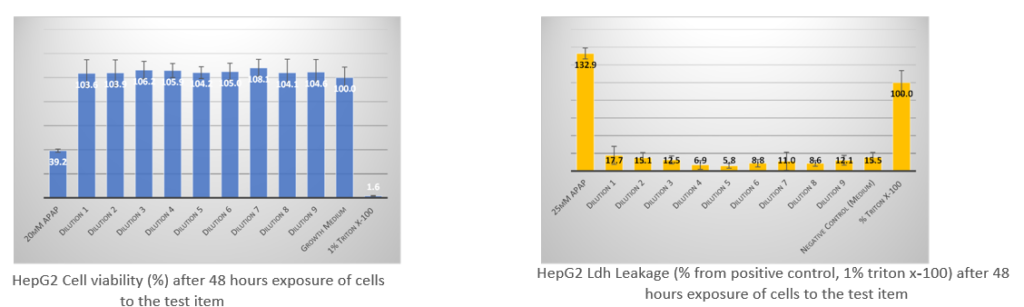
Cytotoxicity effect of Nanoparticulate Materials are evaluated in Porcine Kidney Cells (LLC-PK1) and Human Hepatocarcinoma cells (HepG2).
The test method consisted of two quantitative indicators for estimation of cytotoxicity:
lactate dehydrogenase (LDH) release and MTT reduction.
The release of LDH indicates membrane damage and MTT reduction indicates loss of cell viability.
Hemolysis Assays –
ASTM F756
Hemolysis effect of Medical
Devices and Materials are evaluated using rabbit whole blood.
It evaluates damage to erythrocytes, either by direct methods, which determine hemolysis due to physical and chemical interactions with erythrocytes, or by indirect methods, which determine hemolysis due to extractable from Medical Devices and Materials.
During the test, Hemoglobin content in the plasma is measured before and after incubation of rabbit whole blood with the Test Item (Medical Device/Material/Extract).
Hemoglobin is measured using Drabkin’s method, which is quantitative colorimetric determination of hemoglobin concentration in whole blood.
Test materials are considered non hemolytic when the hemolytic Index is no more then 2% above the Negative Control.

Hemolysis Assays -
ASTM F756
Hemolysis effect of Medical Devices and Materials are evaluated using rabbit whole blood.
It evaluates damage to erythrocytes, either by direct methods, which determine hemolysis due to physical and chemical interactions with erythrocytes, or by indirect methods, which determine hemolysis due to extractable from Medical Devices and Materials.
During the test, Hemoglobin content in the plasma is measured before and after incubation of rabbit whole blood with the Test Item (Medical Device/Material/Extract).
Hemoglobin is measured using Drabkin’s method, which is quantitative colorimetric determination of hemoglobin concentration in whole blood.
Test materials are considered non hemolytic when the hemolytic Index is no more then 2% above the Negative Control.